
Cut
Sarah becomes a film editor
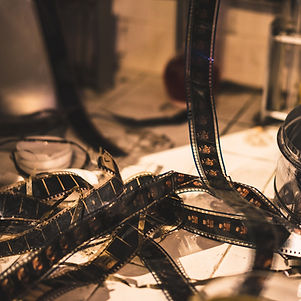
This time, Sarah decided to opt for a career in the film industry. She was too short and unfit to be a camerawoman - all that humping Arriflex about in the name of nostalgic realism. She was too old and plain to be a film actor, unless they wanted a Marie Dressler lookalike. She lacked the confidence and the big voice to be a director. She lacked the financial nous to be a producer. But an editor, now. That might be just the ticket, as she was good at throwing things away (and good at losing them too). Although a maximalist by nature, she yearned for simplicity and clean lines. Editing it should be.
There were, of course, different styles of editing: some long travelling shots almost obviated editing completely, and the editor had to be very subtle and work invisibly: or there was the jump cut, which gave a jagged flow to the narrative. Both these required a lot of technical skill. But Sarah’s favourite was the long dissolve. This was a technique that was cinematically very old-fashioned, archaic almost. When the passage of time was portrayed, one piece of film could be laid on time of another, to show simultaneity and the slow progression of time. Infinitesimally, one moment could meld into another. Sarah became the doyenne of the slow dissolve - she was the first go-to (and sometimes the last resort) of directors who wanted to show ambivalence in the face of change. One good thing about this technique was that very little film was lost on the cutting-room floor: each moment from the past remained there on the screen, a little faded to be sure, but visible nonetheless. It was superimposed upon the next moment, until it was gradually phased out and could be seen no more.
Gradually, Sarah internalised this technical procedure. Her psyche was soft tissue, and bore the imprint of the long dissolve. It became part of her everyday consciousness. When she thought about her past, individual incidents became multi-dimensional: she could see other similar events at the same time, she could see where they came from, what their echoes were. As she was prone to self-flattery, she began to see herself as a sort of Proust of the imagination: a Madeleine was never just a Madeleine. It was dough, it was a crumb on a plate, it was a trophy of the baker’s skill, it was a symbol of - what? - love, pity, regret, hunger.
Hang on. With a shock, she suddenly saw that the long dissolve had led her down a wrong path: circuitous, self-indulgent, status-driven. The moment, whether in the past or the present, deserved more, demanded more. Accordingly Sarah began to think in a different manner, and to pare away the contexts. She had seen the material world and her own life as a series of tracings laid on top of a map. Now she painstakingly pulled the tracing papers away one by one, and tried to see events and things in a clearer light. The space they took. The scent they exuded. The structures they evoked. The textures that could be stroked. The savagery, the tenderness of the moods she had. The moment, both of the past and the present, could now rise in its own magnificence like a new volcanic island emerging from the sea. There it was, the majestic moment.
Of course, this new way of seeing had inevitable consequences for her editing work. She made no announcement, had no fanfare of trumpets. But the critics noticed straight away. They had shouted loudly “Cut! Cut! Cut!” when objecting to the editing in “Last Year at Marienbad”: now they shouted, “Bring back the dissolves!” when they saw the clarity of her new style. But Sarah did not care. Perhaps it was time to find something else to do. Yes.